Compressed air wet receiver 110
Pressure vessel / air receiver · Northgate Works · Packing hall · inspector R. Aldridge
Identification and records
Establish what the vessel is and that its design and inspection history can be evidenced.
Nameplate and general arrangement
9 cues in forceOne frame showing the vessel and, if you can, the data plate.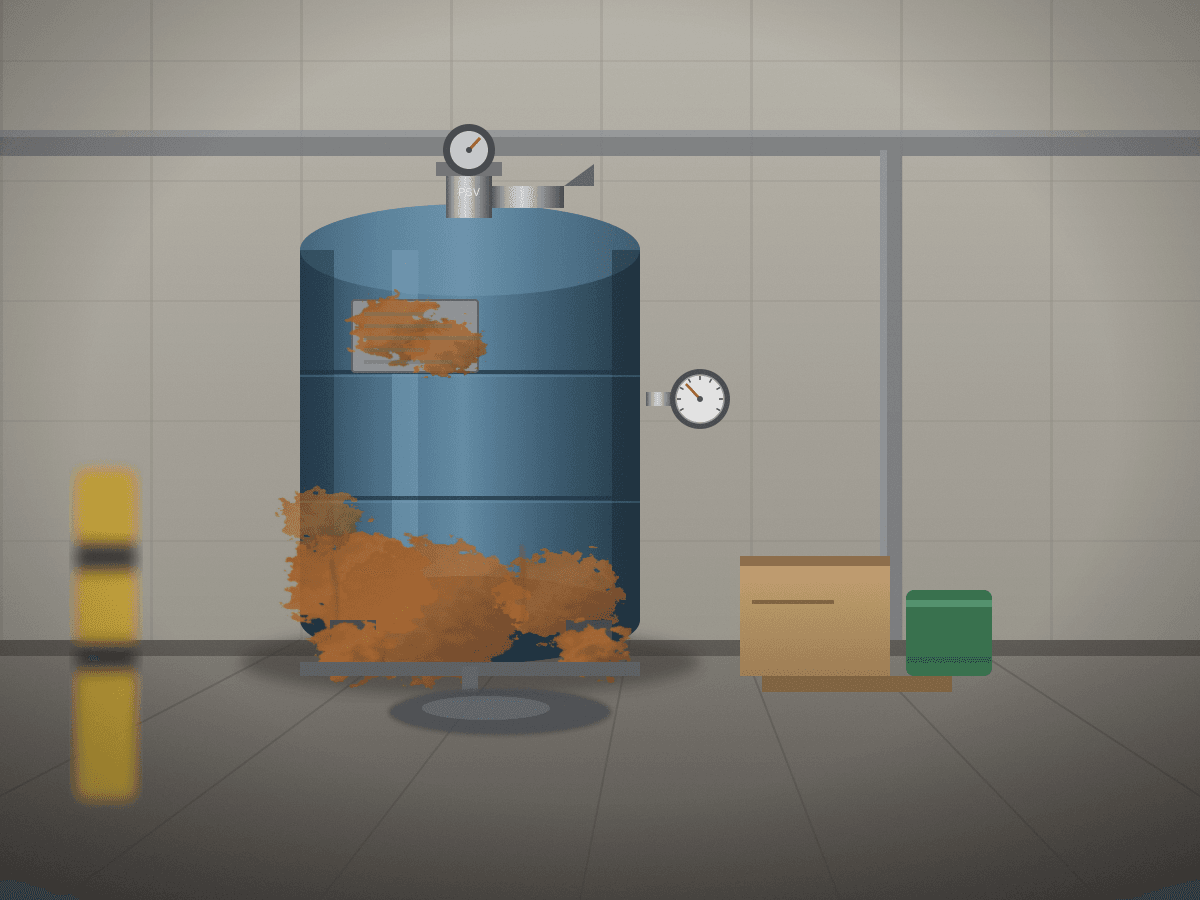
A vertical blue air receiver on a low frame support, with a top-mounted small gauge and PSV, a side-mounted pressure gauge, and extensive orange rust over the lower shell and base — consistent with air receiver 104.
Stylised illustration/render at moderate resolution; small text such as the nameplate stamping and gauge dial markings is not legible, and the left-hand yellow bollard is heavily blurred. Overall arrangement is clear enough to judge most cues.
Lower third of the vessel shell and around the base ring/support legs, centre-left of frame. Large continuous orange-brown flaking rust mass covering the bottom of the shell, spreading onto the support frame and floor; a second rust patch sits on the upper shell at the nameplate area.
Accepting this evaluatesR-PV-06R-PV-07
Rectangular plate on upper left shell, roughly one-third down. A plate-shaped panel is visible but is largely covered by an orange rust bloom; no stamped text can be read.
Accepting this evaluatesR-PV-10
Right of the vessel, in front of the wall column. A cardboard box on a pallet and a green container are stored in the floor space beside the vessel.
Accepting this evaluatesR-PV-15
Floor at the base of the vessel, centre of frame. Rust scale and debris have accumulated on and around the base frame, spilling onto the floor slab.
No enabled rule consumes this cue, so accepting it records evidence only.
Mid shell between the two girth lines. The mid shell appears as clean blue coating; any light staining or chalking cannot be distinguished at this resolution from the heavy rust areas.
No enabled rule consumes this cue, so accepting it records evidence only.
Top head of vessel, valve body labelled 'PSV' with a lever. A relief valve with lift lever is fitted on the top connection; whether an isolation valve, cap or plug sits beneath it is not resolvable, and no discharge pipe is visible.
Accepting this evaluatesR-PV-03
Base of vessel and floor beneath. A grey oval shading on the floor under the vessel could be a shadow or a wet patch; no clear drip trail from any joint or fitting is distinguishable.
Accepting this evaluatesR-PV-16
- Yellow and black bollard at far left is out of focus; its condition and position relative to the vessel cannot be assessed.
- Vessel sits on a low fabricated frame with no visible anchor bolts confirmed in frame.
- No isolation valve, drain line or piping connections are visible on the lower shell.
- Overhead grey rail/duct runs across the wall behind the vessel; no interference with the vessel is apparent.
Recorded on the report as notes. No cue, so no rule consumes them.
2 cues checked and not seen
- Pressure gauge missing, broken or unreadable — Both gauge faces are white, intact and show a pointer; no cracking or fogging visible, though scale markings are too small to read.
- Impact damage or deformation — Shell outline is straight and cylindrical; support legs appear vertical with no visible dents or buckling.